




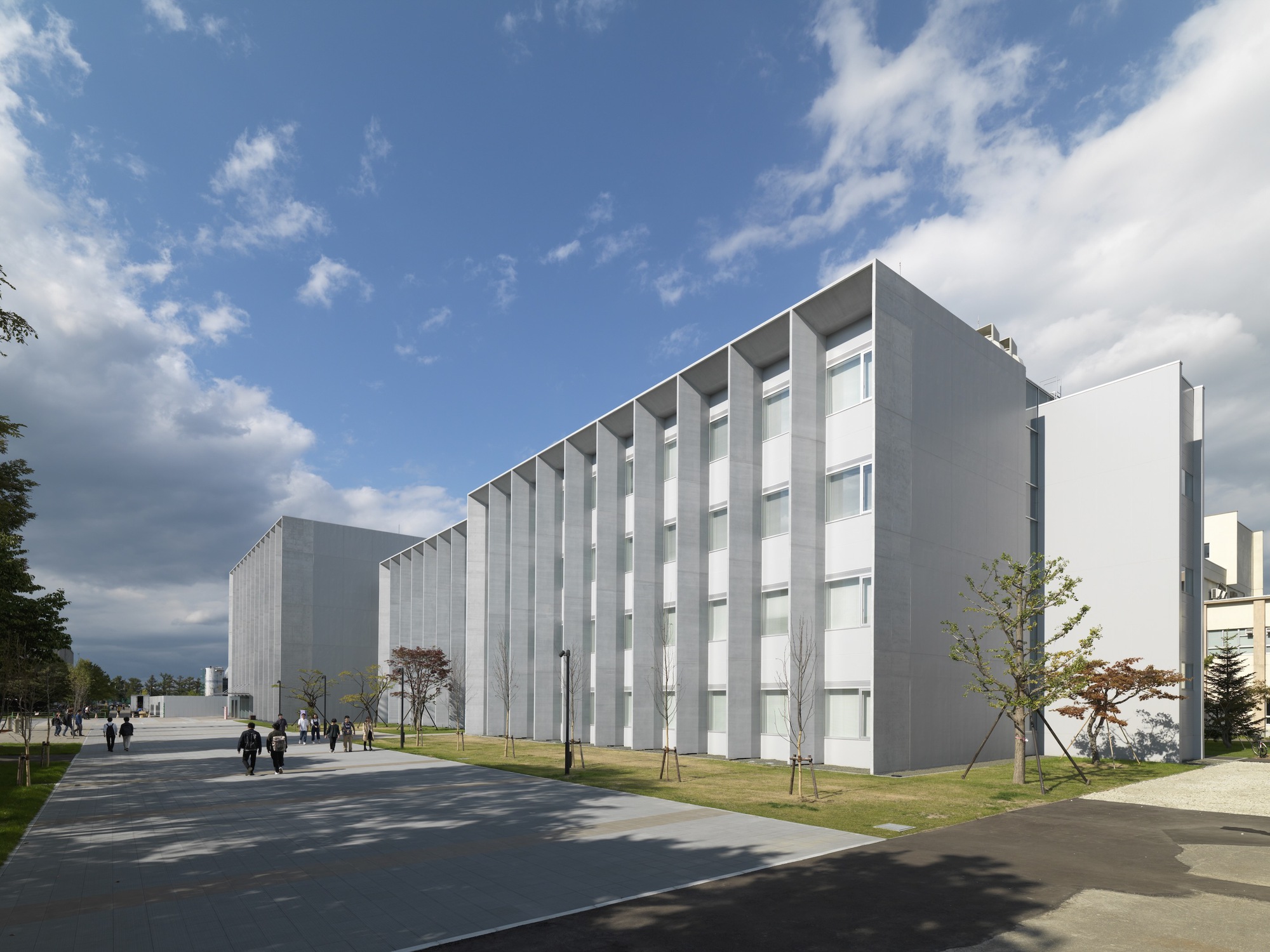
Hokkaido College of Science Buildings DEF / TAISEI DESIGN Planners Architects & Engineers


Textual content description supplied by the architects. There have been many targets to be achieved by Buildings D, E, and F, after they had been deliberate as new buildings of the School of Engineering, Hokkaido College of Science.
- It needs to be potential to assemble them in phases underneath the rolling design idea and to increase them sooner or later.
- They need to be reconfigurable and renewable in order to fulfill altering analysis wants.
- They need to be able to being constructed in a brief time period whereas avoiding lengthy snowbound durations within the snowy area.


To realize these targets, a sequence of common-use zone plates outfitted with a focus of facilities, circulation components, and infrastructure was specified by the longitudinal path of the plan. This method aimed to allow future longitudinal extension alongside the axis of these extensible plates. The extensible system idea utilizing the common-use zone plates was applied, and the buildings, as might be seen at present, had been constructed in three levels within the order of Constructing E (middle), Constructing F (east), and Constructing D (west).


In constructing and tools planning, the attribute system of iteration, seen from the outside look, was meant to impart versatile extensibility and reconfigurability to the interior area shaped by 3-meter modules. The module is designed to serve not solely as a structural unit but in addition as a unit for lighting and air-conditioning installations, so the area shaped by the module connection might be modified simply.

On the building strategy planning stage, the 3-meter unit idea was utilized to industrialization and standardization to cut back labor necessities and keep away from the necessity for building work throughout snowbound durations. Prefabricated members had been assembled on the building web site by repeating the identical procedures to realize constructibility targets, akin to high-quality building and scaffold-less work, whereas on the similar time making the most of economies of scale.


Thus, Buildings D, E, and F of the Hokkaido College of Science showcase the method of creating an extensible and reconfigurable system. The aim of their design was to discover a constructing design that meets important wants with out pursuing exterior architectural elements that at the moment are dominant, akin to sociality and locality. In some instances, the historical past of a constructing determines its design, and consequently, the constructing so designed exhibits its inherent order and wonder.

